
Businesses can still choose to address sustainability

For years, many businesses have at least considered sustainability when running their operations. With the passage of the One, Big, Beautiful Bill Act (OBBBA), however, the federal government has disincentivized businesses from taking certain green measures. For example, the OBBBA permanently eliminates the Section 179D Energy Efficient Commercial Buildings Deduction for buildings or systems on which construction begins after June 30, 2026. Where does this leave your business? It’s up to you and your leadership team whether you want to address sustainability. If it’s something you intend to prioritize, we can help you review your operations and identify cost-effective steps to take.
The new law includes a game-changer for business payment reporting
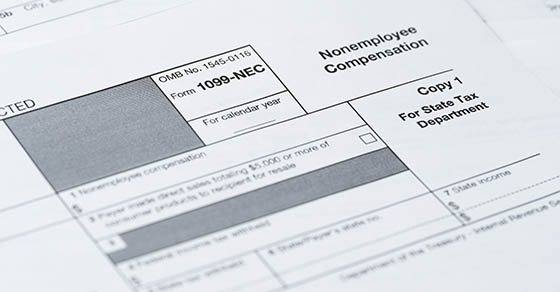
For decades, the IRS has required that businesses file Form 1099-NEC (previously 1099-MISC) for payments made to independent contractors that exceed $600 in a calendar year. This threshold amount has remained unchanged since the 1950s! The One, Big Beautiful Bill Act (OBBBA) contains a major overhaul to this outdated IRS requirement. Beginning with payments made in 2026, the new law raises the threshold for information reporting on certain business payments from $600 to $2,000. Beginning in 2027, the threshold amount will be adjusted for inflation. Contact us with any questions about the new rules or your filing requirements.
Act soon: The OBBBA ends clean energy tax breaks

The One, Big, Beautiful Bill Act eliminates a number of clean energy tax incentives originally introduced or expanded under the Inflation Reduction Act. For example, the clean vehicle tax credit now ends on Sept. 30, 2025 (rather than 2032). The credit provides up to $7,500 for qualifying new electric and fuel cell vehicles, depending on how the battery components and critical minerals are sourced. The maximum manufacturer’s suggested retail price for an eligible vehicle is $55,000 for cars and $80,000 for SUVs, trucks and vans. To qualify, your income must not exceed $150,000 ($300,000 for married couples filing jointly and $225,000 for heads of households). Contact us with any questions.
Is your business ready for digital documents and e-signatures?

In many industries, digital documents and e-signatures are no longer just a convenience; they’re fast becoming the standard. If your business is still relying on paper documents and manual signatures, now may be the time to take a fresh look at what you might be missing. Using digital documents is generally much faster than traditional hard copies, and it’s a strong safeguard against disaster, theft and mishandling. Naturally, before you implement this technology, you should fully understand the legal ramifications, as well as ensure you have up-to-date and effective cybersecurity measures in place. Contact us for help evaluating the costs and potential return on investment.
What you still need to know about the alternative minimum tax after the new law
The alternative minimum tax (AMT) is a separate federal income tax system that bears some resemblance to the regular income tax system. The difference? The individual AMT system taxes certain types of income that are tax-free under the regular system. It also disallows some deductions that are allowed under the regular system. If the AMT exceeds your regular tax bill, you owe the larger AMT amount. Don’t assume you’re exempt from AMT. The One, Big, Beautiful Bill Act increases the odds for taxpayers in certain situations, starting in 2026. For example, some risk factors involve having a high income and exercising incentive stock options. Questions about whether you’re liable? Contact us.
The QBI deduction and what’s new in the One, Big, Beautiful Bill Act
The One, Big, Beautiful Bill Act makes the qualified business income (QBI) deduction permanent. The deduction had been scheduled to end on Dec. 31, 2025. The QBI deduction is a significant tax benefit for many business owners. It allows eligible taxpayers to deduct up to 20% of QBI, which is generally defined as the net amount of qualified income, gain, deduction and loss from a qualified U.S. trade or business. Eligible taxpayers include sole proprietors and owners of pass-through entities, such as partnerships, S corporations and, usually, LLCs. The deduction is reduced or eliminated if the taxpayer’s income exceeds certain amounts. Contact us if you have questions about the QBI deduction.
Developing a comprehensive AI strategy for your business

Artificial intelligence (AI) may help your business streamline operations, improve customer interactions or uncover growth opportunities. However, getting the max benefit calls for a comprehensive strategy. First, identify specific challenges or goals that AI can help you overcome or accomplish. Second, insist on targeted and scalable investments that fit your budget and integrate well with existing software. Third, provide training to help ensure smooth adoption and increase your odds of a solid return on investment. Also, ease employee concerns about job loss or disruption. Last, establish how you’ll measure success and don’t hesitate to make adjustments if necessary. Contact us for help.
Unlocking Bonus Depreciation: The One Big Beautiful Bill Act (OBBBA)

The OBBBA, signed into law on July 4, 2025, reinstates and strengthens several tax incentives. A significant change in this tax incentive was a renewal of the 100% bonus depreciation—originally introduced under the 2017 Tax Cuts and Jobs Act (TCJA). What is Bonus Depreciation? Bonus depreciation allows a business to accelerate the depreciation of qualifying […]
What families need to know about the new tax law

The One, Big, Beautiful Bill Act (OBBBA) has introduced tax changes that could affect families. For example, parents who adopt may be eligible for more generous tax relief. Under current law, a tax credit of up to $17,280 is available for eligible costs of adoption in 2025. The credit begins to phase out in 2025 for taxpayers with modified adjusted gross income of $259,190. Beginning in 2025, the OBBBA makes the adoption tax credit partially refundable up to $5,000. This means that eligible families can receive this portion as a refund even if they owe no federal income tax. Previously, the credit was nonrefundable. Contact us if you have questions about how the new law affects your family.
The new law includes favorable changes for depreciating eligible assets

The One Big Beautiful Bill Act makes changes that will help business taxpayers. For example, there are now better rules for depreciating business assets. In addition to restoring 100% bonus depreciation, the new law makes favorable changes to Sec. 179 deductions. For eligible assets placed in service in 2025, the new law increases the maximum that can immediately be written off via first-year depreciation to $2.5 million (up from $1.25 million for 2025 before the law). A phase-out rule reduces the maximum Sec. 179 deduction if, during the year, you place in service eligible assets in excess of $4 million. (up from $3.13 million for 2025 before the law). Questions? Contact us.
You must be logged in to post a comment.